Thursday, 10 May 2012

Wednesday, 9 May 2012
Tuesday, 1 May 2012
div style="width:425px" id="__ss_12755419">Question 3-what kind of media institution might want to distribute your film and why?
View more presentations from kiamocheddah.
Tuesday, 24 April 2012
Monday, 23 April 2012
Question 4
Who would be the audience for your media product?
https://blogger.googleusercontent.com/img/b/R29vZ2xl/AVvXsEiGXxmrXR6IX2B3yiQLVJaB0H7b0fMNF_ZZu4TNrcHxETCR2gy0L9OCBayCuMo2fB1N1k8heNWaznXNe-xmzYaQfEgT-d0OJr3yAD7olqoU9kawjuoPrg8QJy85b4PTjMLUOVkq6dHqqxEM/s1600/liam.jpg
This is Shane Thomas; he lives in South London, Brixton. Liam enjoys various different film genres but most enjoys Thriller and action/gangster movies. When Liam was in his early teens, his favourite movies to watch were Scarface and then later enjoyed watching American Gangster, he even said he'd 'like to be Frank Lucas for a day so that he could be a self made millionaire within 24 hours'. Liam, who is now 18, has adapted to the nerve wrecking thriller genre and second to Scarface, comes an American werewolf in London. Liam’s wardrobe is full of hoodies, jeans and jumpers and a few pairs of trainers he had bought from stores such as Footlocker and Sports World. He shops in places like Blue Inc, Westside and also JD. Liam plays different sports such as football, basketball and athletics. over the years the music genres he often listens to have changed, he used to listen to a lot of UK grime and also ‘Bashment’ but now listens to Hip-Hop, rap and says that artists such as Tupac, Wu Tang Clan, Dead Prez, TDE, NWA inspire him to also write music. He also told us how he's 'learnt more about the world by listening to Tupacs lyrics that he has in school or watching mis-leading new'.
The reason I think that my film will appeal to Liam is because it is based on a 18 year old boy, making his way home after a late night of partying and then suddenly discovering something shocking. Liam had also told me that he enjoys unpredictable movies because they get him feeling anxious and eager to see what happens next and my film is unique and unpredictable in the way that the audience wouldn’t expect Jordan to discover what he had discovered. Our main target audience would most likely be for active teenagers/adults within the age range of 18 to 21 like Liam. This is Due to the heart-rate racing scenes in the film, the action and the energetic nature of the movie which is targeted to these young adults as they share similarities of the same active characteristics. Our storyline will have these young adults thinking and trying to solve out the mystery of the storyline and characters, which is always exciting.
https://blogger.googleusercontent.com/img/b/R29vZ2xl/AVvXsEiGXxmrXR6IX2B3yiQLVJaB0H7b0fMNF_ZZu4TNrcHxETCR2gy0L9OCBayCuMo2fB1N1k8heNWaznXNe-xmzYaQfEgT-d0OJr3yAD7olqoU9kawjuoPrg8QJy85b4PTjMLUOVkq6dHqqxEM/s1600/liam.jpg
This is Shane Thomas; he lives in South London, Brixton. Liam enjoys various different film genres but most enjoys Thriller and action/gangster movies. When Liam was in his early teens, his favourite movies to watch were Scarface and then later enjoyed watching American Gangster, he even said he'd 'like to be Frank Lucas for a day so that he could be a self made millionaire within 24 hours'. Liam, who is now 18, has adapted to the nerve wrecking thriller genre and second to Scarface, comes an American werewolf in London. Liam’s wardrobe is full of hoodies, jeans and jumpers and a few pairs of trainers he had bought from stores such as Footlocker and Sports World. He shops in places like Blue Inc, Westside and also JD. Liam plays different sports such as football, basketball and athletics. over the years the music genres he often listens to have changed, he used to listen to a lot of UK grime and also ‘Bashment’ but now listens to Hip-Hop, rap and says that artists such as Tupac, Wu Tang Clan, Dead Prez, TDE, NWA inspire him to also write music. He also told us how he's 'learnt more about the world by listening to Tupacs lyrics that he has in school or watching mis-leading new'.
The reason I think that my film will appeal to Liam is because it is based on a 18 year old boy, making his way home after a late night of partying and then suddenly discovering something shocking. Liam had also told me that he enjoys unpredictable movies because they get him feeling anxious and eager to see what happens next and my film is unique and unpredictable in the way that the audience wouldn’t expect Jordan to discover what he had discovered. Our main target audience would most likely be for active teenagers/adults within the age range of 18 to 21 like Liam. This is Due to the heart-rate racing scenes in the film, the action and the energetic nature of the movie which is targeted to these young adults as they share similarities of the same active characteristics. Our storyline will have these young adults thinking and trying to solve out the mystery of the storyline and characters, which is always exciting.
Question one: email : fatimasultan12764@hotmail.co.uk. password: fatimasultan12
http://prezi.com/d3ohobhran2h/edit/#3
Sunday, 22 April 2012

The outfit in which Jordan appears to be wearing is a body warmer hoodie in this shot of his upper body. Id say that Jordan does look like a young black male who is vulnerable to being stereotyped in to a racial category. The hoodie which is the main prop that I want to focus on for this question is to some, a symbol of trouble and connotes violence. The weak implication that this piece of clothing can represent a specific social group who by wearing a hoodie, want to emit suspicion and hide their identity feeds to the negative stereotype of young teenagers and young black teenagers in particular. The audience may reflect that by seeing Jordan, walking through the park and wearing a hoodie, that the film may be based on a gang crime storyline whereas other's may not. Viewers may think that there is nothing suspicious about Jordan and ignore attributing and judging him based on his clothing and the colour of his skin. Within the first few second of this scene, we do project a stereotype however the audience will then go on to learn that ‘’just because someone wears a hoodie does not make them a hoodlum’’.
Jordan has a worried yet surprised expression on his face which only makes the viewer assume that he’s not within reach of safety in this particular shot.
The lonely grey background adds more anxiety to the scene as well as Jordan's body language which is giving off the impression that he is scared and not safe.
Friday, 30 March 2012
the role of an editor (From Wiki)
Film editing is part of the creative post-production process of filmmaking. It involves the selection and combining of shots into sequences, and ultimately creating a finished motion picture. It is an art of storytelling. Film editing is the only art that is unique to cinema, separating film-making from other art forms that preceded it (such as photography, theater, dance, writing, and directing), although there are close parallels to the editing process in other art forms like poetry or novel writing. Film editing is often referred to as the "invisible art"[1] because when it is well-practiced, the viewer can become so engaged that he or she is not even aware of the editor's work.
On its most fundamental level, film editing is the art, technique, and practice of assembling shots into a coherent whole. A film editor is a person who practices film editing by assembling the footage. However, the job of an editor isn’t simply to mechanically put pieces of a film together, cut off film slates, or edit dialogue scenes. A film editor must creatively work with the layers of images, story, dialogue, music, pacing, as well as the actors' performances to effectively "re-imagine" and even rewrite the film to craft a cohesive whole. Editors usually play a dynamic role in the making of a film.
Film editing is an art that can be used in diverse ways. It can create sensually provocative montages; become a laboratory for experimental cinema; bring out the emotional truth in an actor's performance; create a point of view on otherwise obtuse events; guide the telling and pace of a story; create an illusion of danger where there is none; give emphasis to things that would not have otherwise been noted; and even create a vital subconscious emotional connection to the viewer, among many other possibilities.
There are several editing stages and the editor's cut is the first. An editor's cut (sometimes referred to as the "Assembly edit" or "Rough cut") is normally the first pass of what the final film will be when it reaches picture lock. The film editor usually starts working while principal photography starts. Likely, prior to cutting, the editor and director will have seen and/or discussed "dailies" (raw footage shot each day) as shooting progresses. Screening dailies gives the editor a ballpark idea of the director's intentions. Because it is the first pass, the editor's cut might be longer than the final film. The editor continues to refine the cut while shooting continues, and often the entire editing process goes on for many months and sometimes more than a year, depending on the film.
On its most fundamental level, film editing is the art, technique, and practice of assembling shots into a coherent whole. A film editor is a person who practices film editing by assembling the footage. However, the job of an editor isn’t simply to mechanically put pieces of a film together, cut off film slates, or edit dialogue scenes. A film editor must creatively work with the layers of images, story, dialogue, music, pacing, as well as the actors' performances to effectively "re-imagine" and even rewrite the film to craft a cohesive whole. Editors usually play a dynamic role in the making of a film.
Film editing is an art that can be used in diverse ways. It can create sensually provocative montages; become a laboratory for experimental cinema; bring out the emotional truth in an actor's performance; create a point of view on otherwise obtuse events; guide the telling and pace of a story; create an illusion of danger where there is none; give emphasis to things that would not have otherwise been noted; and even create a vital subconscious emotional connection to the viewer, among many other possibilities.
There are several editing stages and the editor's cut is the first. An editor's cut (sometimes referred to as the "Assembly edit" or "Rough cut") is normally the first pass of what the final film will be when it reaches picture lock. The film editor usually starts working while principal photography starts. Likely, prior to cutting, the editor and director will have seen and/or discussed "dailies" (raw footage shot each day) as shooting progresses. Screening dailies gives the editor a ballpark idea of the director's intentions. Because it is the first pass, the editor's cut might be longer than the final film. The editor continues to refine the cut while shooting continues, and often the entire editing process goes on for many months and sometimes more than a year, depending on the film.
Thursday, 29 March 2012
Evaluation question3- How does your media product represent particular social groups?


Charley Brewster(left) is the main character from Fright night. Both characters have similiar facial expressions of fear and they both have their heads turned towards the camera trying to see whether something is there. They are both wearing casual clothes such as a jumper, however Jordan is wearing a body warmer jacket on top of his jumper, a hat and hood. Although the boys seem scared they look like they are on guard ready to fight. The settings differ in the pictures, Charley is in a tight space pulling a handle for a door. This represents young boys as defenseless because he has no where to run in that tiny room. In contrast Jordan is outdoors in the woods however the same represention can be interpreted becuase the woods is so big that Jordan wouldn't know where the supernatural force could be hiding. I chose the character from fright night because the storyline of the film is similiar to ours aswell. Both boys find themselves in a situation against a supernatural force they have to get out of or fight. In Jordans case it is the supernatural force of voodoo which he has to solve and stop whereas Charley's is the supernatural force of a vampire who he has to prevent from killing his loved ones. Overall I think that young teenage boys are being presented as ordinary especially by their clothes, vunerable becuase of the fear on their facial expression and settings but at the same time strong enough to take on extraordinary forces.
Wednesday, 28 March 2012
Evaluation question 6- What have you learnt about technologies from the process of constructing this product?
 Blogging was a new experience for me but I got the hang of it quickly and enjoyed it. I learnt how to post a blog and that I could do presentations form various websites and embed it on the blog. Using blogger taught me that people can blog any topics then want and it has inspried me to create my own blog in the furture.

 We used final cut pro to edit our film and this was the most complex software above all however it was fun getting the hang of it and discovering thing diffect effects we could use to improve our film. I learnt how to capture shots from the tape used in the camera, trim shots and place them on the time line, add text, import music, add special effects such as slow motion and cross dissloves. Lastly, I learnt how to export the film onto CD and memory sticks.


Timetoast was something different which was what I liked about it. I just had to upload pictures saved on a file and type a bit of information about the films. It also required me to know the exact day,month and year that the films were relased so i learnt i had to research that info on the internet


 Wordle
Tuesday, 27 March 2012
Thursday, 8 March 2012
A youtube video that gives an insight into voodoo practises
<iframe width="420" height="315" src="http://www.youtube.com/embed/xRt6CTb6riY" frameborder="0" allowfullscreen></iframe>
Trailor of film 'Skeleton Key'
<iframe width="560" height="315" src="http://www.youtube.com/embed/OhPaWz4xzdc" frameborder="0" allowfullscreen></iframe>
I posted the trailor of this film because it is about voodooo which is the theme of our film.
I posted the trailor of this film because it is about voodooo which is the theme of our film.
Tuesday, 6 March 2012
Main target audience

Our main target audience would most likely be for active teenagers/adults within the age range of 18 to 21. Due to the repulsive, heart-rate racing scenes in the film, we intended to think of aspects in a thriller movie which would attract teenage adults. afterall, the loud, active, energetic nature of the film shares those same characteristics and similarities as the average 18 year old. Our storyline will have these young adults thinking and trying to solve out the mystery of the storyline and characters.
VOODOO


I found these image on google and chose to post them because of the corrupt and unique messages each photo projects; This shares obvious similarities with our storyline.
OTHER IDEAS WE DIDNT USE FOR OUR THRILLER AND REASONS
Alternative storylines
Idea 1
pregnant woman shopping
cannibal
Idea 2
abortion photo
Idea 3
Reason/s why we didnt use idea 1
Reason/s why we didnt use Idea 2
Reason/s why we didnt use Idea 3
Reason/s why we didnt use Idea 4
Idea 1
- the main character is a cannibal obssessed with preganant woman and unborn babies
- heavily pregnant woman will be seen alone window shopping for baby clothes unaware that the cannibal character is watching her.
- she then walks home alone through the pitch black woods which leads to her usual pathway home
- the cannibal man will follow her into the woods and hlod her hostage and kill her .Then savagely ripping out her baby and eating it.
pregnant woman shopping
cannibal
Idea 2
- Two guys and their pregnant friend are walking home late through the alleyway to get home
- the two guys are immature and drunk
- the pregnant lady is sober and tired desperate to get home
- the guys are messing around play fighting and still drinking alcohol
- one of the guys then stumbles upon photographs of aborted fetus' and other images of pregnant woman
abortion photo
Idea 3
- the character visits the scene of his best friends death on the anniversary of his death
- he starts hearing strange noises and seeing shadows surrounding him while reading get well soon messages in tribute to his friend
- he spots a message saying " ROT IN HELL ,YOU'VE BROUGHT THE DEVIL DOWN!"
- when he reads the back of the message it says a gangwarfare code liked to his dead friend
- funeral flowers
- image of gang code
IDEA 4
- Two best mates are walking through the woods after a late night partying
- They are still drunk from last nights events so they are oblivious to the fact that they are walking through the woods
- one of them ends up tripping and discovers the face of a dead baby
Reason/s why we didnt use idea 1
- the location we chose would be too hard to film at night because of the limited lighting and lightning equipment needs to plugged into an electrical plug to work.
Reason/s why we didnt use Idea 2
- it would be hard to find 3 available actors for the filming
- The location was not in close distance for everyone to meet up and film so more time would be lost due to waiting for the group
Reason/s why we didnt use Idea 3
- we could not develop the plot line even further such as making it more thriller based so we decided to leave this idea alone
Reason/s why we didnt use Idea 4
- it would be easier filming just one character
- so we could focus more on just the individual shooting of facial expressions,over the shoulder shots ,p.o.v etc
- the other actor was not available on the day we were refilming some scenes
Monday, 5 March 2012
Alfred Hitchcock's Background
This is a brief over view of alfred hitchcocks life and profession. The paragraph highlighted has the most relevant information.
Sir Alfred Joseph Hitchcock, KBE (13 August 1899 – 29 April 1980) was a British film director, producer and cameo appearance actor. He pioneered many techniques in the suspense and psychological thriller genres. After a successful career in British cinema in both silent films and early talkies, Hitchcock moved to Hollywood.
In 1956, he became an American citizen while remaining a British subject.
Over a career spanning more than half a century, Hitchcock fashioned for himself a distinctive and recognisable directorial style. He pioneered the use of a camera made to move in a way that mimics a person's gaze, forcing viewers to engage in a form of voyeurism. He framed shots to maximise anxiety, fear, or empathy, and used innovative film editing. His stories frequently feature fugitives on the run from the law alongside "icy blonde" female characters. Many of Hitchcock's films have twist endings and thrilling plots featuring depictions of violence, murder, and crime, although many of the mysteries function as decoys or "MacGuffins" meant only to serve thematic elements in the film and the extremely complex psychological examinations of the characters. Hitchcock's films also borrow many themes from psychoanalysis and feature strong sexual undertones. Through his cameo appearances in his own films, interviews, film trailers, and the television program Alfred Hitchcock Presents, he became a cultural icon.
Hitchcock directed more than fifty feature films in a career spanning six decades. Often regarded as the greatest British filmmaker, he came first in a 2007 poll of film critics in Britain's Daily Telegraph, which said: "Unquestionably the greatest filmmaker to emerge from these islands, Hitchcock did more than any director to shape modern cinema, which would be utterly different without him. His flair was for narrative, cruelly withholding crucial information (from his characters and from us) and engaging the emotions of the audience like no one else." The magazine MovieMaker has described him as the most influential filmmaker of all-time, and he is widely regarded as one of cinema's most significant artists.
http://en.wikipedia.org/wiki/Alfred_Hitchcock#cite_note-Heritage02-28-07-3
Sir Alfred Joseph Hitchcock, KBE (13 August 1899 – 29 April 1980) was a British film director, producer and cameo appearance actor. He pioneered many techniques in the suspense and psychological thriller genres. After a successful career in British cinema in both silent films and early talkies, Hitchcock moved to Hollywood.
In 1956, he became an American citizen while remaining a British subject.
Over a career spanning more than half a century, Hitchcock fashioned for himself a distinctive and recognisable directorial style. He pioneered the use of a camera made to move in a way that mimics a person's gaze, forcing viewers to engage in a form of voyeurism. He framed shots to maximise anxiety, fear, or empathy, and used innovative film editing. His stories frequently feature fugitives on the run from the law alongside "icy blonde" female characters. Many of Hitchcock's films have twist endings and thrilling plots featuring depictions of violence, murder, and crime, although many of the mysteries function as decoys or "MacGuffins" meant only to serve thematic elements in the film and the extremely complex psychological examinations of the characters. Hitchcock's films also borrow many themes from psychoanalysis and feature strong sexual undertones. Through his cameo appearances in his own films, interviews, film trailers, and the television program Alfred Hitchcock Presents, he became a cultural icon.
Hitchcock directed more than fifty feature films in a career spanning six decades. Often regarded as the greatest British filmmaker, he came first in a 2007 poll of film critics in Britain's Daily Telegraph, which said: "Unquestionably the greatest filmmaker to emerge from these islands, Hitchcock did more than any director to shape modern cinema, which would be utterly different without him. His flair was for narrative, cruelly withholding crucial information (from his characters and from us) and engaging the emotions of the audience like no one else." The magazine MovieMaker has described him as the most influential filmmaker of all-time, and he is widely regarded as one of cinema's most significant artists.
http://en.wikipedia.org/wiki/Alfred_Hitchcock#cite_note-Heritage02-28-07-3
Alfred Hitchcock on the difference of mystery and suspense
I have uploaded this video as alfred hitchcock explains the difference between two key elements of a thriller film, which are "suspense" and "mystery". This can be used to understand how to put these elements into our production.
Trailer of the sixth sense
I have chosen to upload this trailer as it is also a trailer to a good thriller film called the sixth sense. This could also be analysed for good habbits and tricks that can be used for our production.
Film Trailer of psycho
I chose to upload this film trailer as it is the trailer to one of most recognised and highly rated thriller films of all time. The film psycho was directed by Alfred Hitchcock who also is a highly repsected specialist of directing thriller films. My group could watch the whole film and analyse it in order to use certain aspects such as camera shots and mise en scene in order to make our production more effective.
Insite in to the different types of film producers
Even though the role of a film producer is seen to be quite straight forward, that is not the case. There are many different types of film producers. The different types of film producers are:
Executive Producer
An Executive Producer supervises one or more producers in the performance of all of his/her producer functions on single or multiple productions. For example, all television series producers answer to the Executive Producer.. The same rule generally applies to motion picture production.
Co-Producer
A Co-Producer is usually someone who works under the supervision of a producer or Executive Producer. For example, someone who has acquired the rights to a property such as a book or a screenplay will often be assigned the role of Co-Producer in acknowledgement for helping to package and sell the project.
Line Producer
The Line Producer is a nuts and bolts hands-on person who is responsible on behalf of management for overseeing the crew and day-to-day operation of the production from pre-production, commencement of Principal Photography, through the Wrap of the shoot. Sometimes, the Unit Production Manager (UPM) will be assigned the dual roles of UPM and Line Producer for a given shoot, in which case that person will receive on-screen credit both as UPM and Line Producer and also be compensated for both functions.
Associate Producer
An Associate Producer performs one or more producer functions which are delegated to him/her by a producer, working directly for and under the supervision of the producer of record. The Associate Producer is also someone who is a nuts and bolts
person, working under the jurisdiction of the Line Producer.
http://www.hollywoodlitsales.com/cf/journal/dspJournal.cfm?intID=2058
Executive Producer
An Executive Producer supervises one or more producers in the performance of all of his/her producer functions on single or multiple productions. For example, all television series producers answer to the Executive Producer.. The same rule generally applies to motion picture production.
Co-Producer
A Co-Producer is usually someone who works under the supervision of a producer or Executive Producer. For example, someone who has acquired the rights to a property such as a book or a screenplay will often be assigned the role of Co-Producer in acknowledgement for helping to package and sell the project.
Line Producer
The Line Producer is a nuts and bolts hands-on person who is responsible on behalf of management for overseeing the crew and day-to-day operation of the production from pre-production, commencement of Principal Photography, through the Wrap of the shoot. Sometimes, the Unit Production Manager (UPM) will be assigned the dual roles of UPM and Line Producer for a given shoot, in which case that person will receive on-screen credit both as UPM and Line Producer and also be compensated for both functions.
Associate Producer
An Associate Producer performs one or more producer functions which are delegated to him/her by a producer, working directly for and under the supervision of the producer of record. The Associate Producer is also someone who is a nuts and bolts
person, working under the jurisdiction of the Line Producer.
http://www.hollywoodlitsales.com/cf/journal/dspJournal.cfm?intID=2058
Jordans Role - Producer. The role of a producer.
A film producer oversees and delivers a film project to all relevant hosts while preserving the integrity, voice and vision of the film. They will also often take on some financial risk by using their own money, especially during the pre-production period, before a film is fully financed. Many film producers are also talent (directors, screenwriters, actors) but that is not always the case.
The producer is often actively involved throughout all major phases of the filmmaking process, from inception and development to completion and delivery of a film project. However, an idea or concept for a film can originate with any individual, including a screenwriter, a director or a producer.
A producer begins by obtaining the rights to create or co-create a feature-length screenplay. The producer oversees the process, which includes coordinating, supervising and controlling major aspects of the project. This includes fundraising and hiring key roles such as the casting director or film director. They'll also influence the hiring of other personnel such as the UPM or line producer and accountant.
http://en.wikipedia.org/wiki/Film_producer
The producer is often actively involved throughout all major phases of the filmmaking process, from inception and development to completion and delivery of a film project. However, an idea or concept for a film can originate with any individual, including a screenwriter, a director or a producer.
A producer begins by obtaining the rights to create or co-create a feature-length screenplay. The producer oversees the process, which includes coordinating, supervising and controlling major aspects of the project. This includes fundraising and hiring key roles such as the casting director or film director. They'll also influence the hiring of other personnel such as the UPM or line producer and accountant.
| “ | From the first draft script, through all stages of production, to the final dub, success or failure rests largely in the hands of the producer. Experience in this field does not come overnight. Rather it is born out of long years of creative and technical know-how, and above all a love for the job and all that goes with it, together with the ability to choose the right talent with which to surround himself. | ” |
http://en.wikipedia.org/wiki/Film_producer
Article by Neil Sinyard talking about Thrillers (BFI website)
I like this article because it gives an insight into the history and development of thriller films and also why the thriller genre is so popular. I underlined parts i thought explained why we love thrillers so much.
"The suspense is terrible," says Gwendolen in Oscar Wilde's The Importance of Being Earnest (1895), before adding, "I hope it will last." This witticism contains an intriguing paradox. Why is it that we both fear and enjoy being frightened? Alfred Hitchcock always thought it started in a mother's arms, when she says 'Boo!' to her child, who is first startled and then delighted. In the cinema, this sensation might have originated in the first public screenings of films by the Lumière brothers in 1895. "A train appears on the screen," wrote Maxim Gorky in a memorable newspaper review. "It speeds straight at you - watch out! It seems as though it will plunge into the darkness in which you sit..." Some audiences did indeed flee the theatres in terror, but they must have returned, because the cinema had soon established itself as the most popular mass medium of the early twentieth century.
Audiences went to the cinema not simply to see but also to feel something which they would not ordinarily experience in real life. At one extreme, they were enthralled by the ingenuity of the dog in Rescued by Rover (1905) as it discovers the whereabouts of a kidnapped child. At another, they shuddered as the title character of F.W. Murnau's Nosferatu (Germany, 1922) makes his sinister progress to the heroine's bedchamber. Something of that film's eerie atmosphere seeped into the first thriller masterpiece of the British cinema, The Lodger (1926); and the first major British talkie, Blackmail (1929) was also a thriller, using sound particularly imaginatively in the scene when the recurrence of the word 'knife' in the mouth of a gossipy neighbour presses on the heroine's guilty conscience like an exposed nerve.
The director of both films was the young Alfred Hitchcock, who declared his intention "to give the public good healthy mental shake-ups". So he supplied a string of films during the 1930s - including The Man Who Knew Too Much (1934), The 39 Steps (1935), Sabotage (1936) and The Lady Vanishes (1938) - which set the standard by which future English thrillers were to be judged. They also set some important ground rules. In the thriller, whodunit is not that important, and unlike the gangster or the crime film, the leading protagonist can be an innocent bystander who gets caught up in the adventure, like Richard Hannay (Robert Donat) in The 39 Steps. In this way, an audience is gripped because the hero is an Everyman figure grappling with unexpected danger not too far removed from possibility. Needless to say, not all thrillers of the decade were of that quality, least of all - with a few exceptions - the so-called 'quota quickies', supporting features designed to fulfil as cheaply as possible quota requirements for British films. Nevertheless, films like Carol Reed's Night Train to Munich (1938) and Thorold Dickinson's The Arsenal Stadium Mystery (1939) had something of Hitchcock's verve.
During the war, the thriller was pressed into service to guard people against complacency. Dickinson's Next of Kin (1942) warned that 'careless talk costs lives', while Alberto Cavalcanti's Went the Day Well? (1942) was a disturbing fantasy about a possible German invasion of England. The latter was based on a story by Graham Greene, who scripted three of the best British thrillers of the late 1940s, the Boulting Brothers' Brighton Rock (1947), based on his own novel, and two films directed by Carol Reed, The Fallen Idol (1948) and The Third Man (1949), the former a study of innocence and experience, the latter an extraordinary evocation of the amorality of post-war Europe. Prior to these films, Reed had also directed the outstanding Odd Man Out (1947), which, alongside two films of the same year, Cavalcanti's They Made Me a Fugitive and Robert Hamer's It Always Rains on Sunday, cast a noirish gloom across post-war tales of betrayal and disillusionment.
The most significant thrillers of the next decade or so often combined suspense with a social conscience. Particularly adept at this were the producer-director team of Michael Relph and Basil Dearden, examining the policeman's lot in The Blue Lamp (1950), racial prejudice in Sapphire (1959) and homosexuality in the groundbreaking Victim (1961). Similarly, the Boulting Brothers' Seven Days to Noon (1950) combined an exciting race-against-time structure with a thoughtful sub-text about the dangers of atomic research. Forced into exile during the McCarthyist era in America, Joseph Losey brought a stylistic flamboyance to Time Without Pity (1957) and Blind Date (1959) but also brought his socialist sympathies to bear in attacking capital punishment in the former film and exposing class hypocrisy and police malpractice in the latter. Another blacklisted American, Cy Endfield also enlivened the English scene with the exciting Hell Drivers (1957) and with a B-feature, Impulse (1955), made for Robert S. Baker and Monty Berman's Tempean films, which produced some competent low-budget thrillers during this period. The most controversial thriller of the time, however, was undoubtedly Michael Powell's Peeping Tom (1960), which, brilliantly but disturbingly, analysed the tortured psychology of its hero and implicated the audience in his anguished voyeurism.
It would be fair to say that the antics of James Bond rather overshadowed most British attempts to revitalise the thriller in the 1960s. Indeed, refreshment came from abroad, with two remarkable films from European auteurs working in London. Roman Polanski's Repulsion (1965) clinically observed the mental breakdown of a lonely young woman (Catherine Deneuve) whose alienation will lead her to murder. Michelangelo Antonioni's Blow-Up (1966) told an ambiguous tale of a fashionable London photographer who films an incident in a park that looks like a harmless love scene but, on closer photographic inspection, could be a murder. The artistic ambition of that film was to be matched at the end of the decade by Donald Cammell's and Nicolas Roeg's Performance (1970), in which a reclusive pop star begins to play deadly mind games with a gangster on the run who has stumbled into his lair. Roeg was later to top this with the cinematically adventurous Don't Look Now (1973), which added sensuality and the supernatural to breathtaking suspense.
In subsequent years, some of the most interesting thrillers stiffened their suspense with political undertones. If Richard Lester's Juggernaut (1974) seemed in part to use its situation of an ocean liner in peril as an audacious metaphor for the last days of Edward Heath's Conservative Government, later films like John Mackenzie's The Long Good Friday (1979), David Drury's The Defence of the Realm (1985) and Peter Greenaway's The Cook, the Thief, His Wife and Her Lover (1989) spun tense tales of entrepreneurial greed, political conspiracy and materialist rapacity to communicate what they saw as the ruthless values of Thatcherism.
Recent examples have tended to lack that political and social edge and have been slick but relatively conventional in their dramatic strategies, such as Danny Boyle's Shallow Grave (1994) and two popular gangster-thrillers, Guy Ritchie's Lock, Stock and Two Smoking Barrels (1998) and Jonathan Glazer's Sexy Beast (2000). Nowadays it is more common to find a good British thriller on television than in the cinema, but it remains a fascinatingly flexible form that, at its best, can undermine complacency through a dramatic rendering of psychological, social, familial and political tensions; and can encourage sheltered but sensation-hungry audiences, in Hitchcock's phrase, "to put their toe in the cold water of fear to see what it's like."
"The suspense is terrible," says Gwendolen in Oscar Wilde's The Importance of Being Earnest (1895), before adding, "I hope it will last." This witticism contains an intriguing paradox. Why is it that we both fear and enjoy being frightened? Alfred Hitchcock always thought it started in a mother's arms, when she says 'Boo!' to her child, who is first startled and then delighted. In the cinema, this sensation might have originated in the first public screenings of films by the Lumière brothers in 1895. "A train appears on the screen," wrote Maxim Gorky in a memorable newspaper review. "It speeds straight at you - watch out! It seems as though it will plunge into the darkness in which you sit..." Some audiences did indeed flee the theatres in terror, but they must have returned, because the cinema had soon established itself as the most popular mass medium of the early twentieth century.
Audiences went to the cinema not simply to see but also to feel something which they would not ordinarily experience in real life. At one extreme, they were enthralled by the ingenuity of the dog in Rescued by Rover (1905) as it discovers the whereabouts of a kidnapped child. At another, they shuddered as the title character of F.W. Murnau's Nosferatu (Germany, 1922) makes his sinister progress to the heroine's bedchamber. Something of that film's eerie atmosphere seeped into the first thriller masterpiece of the British cinema, The Lodger (1926); and the first major British talkie, Blackmail (1929) was also a thriller, using sound particularly imaginatively in the scene when the recurrence of the word 'knife' in the mouth of a gossipy neighbour presses on the heroine's guilty conscience like an exposed nerve.
The director of both films was the young Alfred Hitchcock, who declared his intention "to give the public good healthy mental shake-ups". So he supplied a string of films during the 1930s - including The Man Who Knew Too Much (1934), The 39 Steps (1935), Sabotage (1936) and The Lady Vanishes (1938) - which set the standard by which future English thrillers were to be judged. They also set some important ground rules. In the thriller, whodunit is not that important, and unlike the gangster or the crime film, the leading protagonist can be an innocent bystander who gets caught up in the adventure, like Richard Hannay (Robert Donat) in The 39 Steps. In this way, an audience is gripped because the hero is an Everyman figure grappling with unexpected danger not too far removed from possibility. Needless to say, not all thrillers of the decade were of that quality, least of all - with a few exceptions - the so-called 'quota quickies', supporting features designed to fulfil as cheaply as possible quota requirements for British films. Nevertheless, films like Carol Reed's Night Train to Munich (1938) and Thorold Dickinson's The Arsenal Stadium Mystery (1939) had something of Hitchcock's verve.
During the war, the thriller was pressed into service to guard people against complacency. Dickinson's Next of Kin (1942) warned that 'careless talk costs lives', while Alberto Cavalcanti's Went the Day Well? (1942) was a disturbing fantasy about a possible German invasion of England. The latter was based on a story by Graham Greene, who scripted three of the best British thrillers of the late 1940s, the Boulting Brothers' Brighton Rock (1947), based on his own novel, and two films directed by Carol Reed, The Fallen Idol (1948) and The Third Man (1949), the former a study of innocence and experience, the latter an extraordinary evocation of the amorality of post-war Europe. Prior to these films, Reed had also directed the outstanding Odd Man Out (1947), which, alongside two films of the same year, Cavalcanti's They Made Me a Fugitive and Robert Hamer's It Always Rains on Sunday, cast a noirish gloom across post-war tales of betrayal and disillusionment.
The most significant thrillers of the next decade or so often combined suspense with a social conscience. Particularly adept at this were the producer-director team of Michael Relph and Basil Dearden, examining the policeman's lot in The Blue Lamp (1950), racial prejudice in Sapphire (1959) and homosexuality in the groundbreaking Victim (1961). Similarly, the Boulting Brothers' Seven Days to Noon (1950) combined an exciting race-against-time structure with a thoughtful sub-text about the dangers of atomic research. Forced into exile during the McCarthyist era in America, Joseph Losey brought a stylistic flamboyance to Time Without Pity (1957) and Blind Date (1959) but also brought his socialist sympathies to bear in attacking capital punishment in the former film and exposing class hypocrisy and police malpractice in the latter. Another blacklisted American, Cy Endfield also enlivened the English scene with the exciting Hell Drivers (1957) and with a B-feature, Impulse (1955), made for Robert S. Baker and Monty Berman's Tempean films, which produced some competent low-budget thrillers during this period. The most controversial thriller of the time, however, was undoubtedly Michael Powell's Peeping Tom (1960), which, brilliantly but disturbingly, analysed the tortured psychology of its hero and implicated the audience in his anguished voyeurism.
It would be fair to say that the antics of James Bond rather overshadowed most British attempts to revitalise the thriller in the 1960s. Indeed, refreshment came from abroad, with two remarkable films from European auteurs working in London. Roman Polanski's Repulsion (1965) clinically observed the mental breakdown of a lonely young woman (Catherine Deneuve) whose alienation will lead her to murder. Michelangelo Antonioni's Blow-Up (1966) told an ambiguous tale of a fashionable London photographer who films an incident in a park that looks like a harmless love scene but, on closer photographic inspection, could be a murder. The artistic ambition of that film was to be matched at the end of the decade by Donald Cammell's and Nicolas Roeg's Performance (1970), in which a reclusive pop star begins to play deadly mind games with a gangster on the run who has stumbled into his lair. Roeg was later to top this with the cinematically adventurous Don't Look Now (1973), which added sensuality and the supernatural to breathtaking suspense.
In subsequent years, some of the most interesting thrillers stiffened their suspense with political undertones. If Richard Lester's Juggernaut (1974) seemed in part to use its situation of an ocean liner in peril as an audacious metaphor for the last days of Edward Heath's Conservative Government, later films like John Mackenzie's The Long Good Friday (1979), David Drury's The Defence of the Realm (1985) and Peter Greenaway's The Cook, the Thief, His Wife and Her Lover (1989) spun tense tales of entrepreneurial greed, political conspiracy and materialist rapacity to communicate what they saw as the ruthless values of Thatcherism.
Recent examples have tended to lack that political and social edge and have been slick but relatively conventional in their dramatic strategies, such as Danny Boyle's Shallow Grave (1994) and two popular gangster-thrillers, Guy Ritchie's Lock, Stock and Two Smoking Barrels (1998) and Jonathan Glazer's Sexy Beast (2000). Nowadays it is more common to find a good British thriller on television than in the cinema, but it remains a fascinatingly flexible form that, at its best, can undermine complacency through a dramatic rendering of psychological, social, familial and political tensions; and can encourage sheltered but sensation-hungry audiences, in Hitchcock's phrase, "to put their toe in the cold water of fear to see what it's like."
Neil Sinyard
Different Shots
This is a video showing all the different shots that can be used in a film. The ones we chose to use are the most effective for our sequence. These were close ups, long shots, extreme close ups, over the shoulder shot and tracking.
<=http://barefootted.com/labels/huaraches.html&docid=StO2R5KZ5qSJqM&imgurl=http://barefootted.com/uploaded_images/AC100Train0520_FEET-708213.jpg&w=400&h=317&ei=paFUT_3hFceg8QPYta3vBQ&zoom=1&iact=rc&dur=47&sig=117687058226333602541&page=2&tbnh=135&tbnw=182&start=15&ndsp=21&ved=1t:429,r:8,s:15&tx=93&ty=101
Sunday, 4 March 2012
Fatima’s role: director. Research on film directors.
Director
A film director role is needed on the set in order to direct the actors and film crew in the making of the film. They specialise in the artistic and dramatic aspects of the film. By constructing their own vision of how the film should look, there job is to then make their vision come to life. They often use a storyboard; this helps them decide the camera angles, and the order in which their shots should go in. As well as responsibility on for the camera angles, they also have responsibility on aspects such as the lighting and lens effects however they would often need the help of a cinematographer, set designer and production designer.
A director also has to play a role in post production. He or she has to then work with the editor to ensure that the emotions of the scene and the close ups, mid-shots and wide or long shots appropriately reflect which character is driving the narrative. The director will sometimes participate in the sound mix and musical composition of the film. In the subsequent promotion of the finished film, if a director is well known his name and image is used to promote the film alongside the stars of the film, but having an image is not the primary function of a director, as they are judged by their creative talent and ability to run a production. It is the second most powerful "behind the scenes" profession in the movie industry, after the producer, but the director traditionally has complete control "on the floor".
http://en.wikipedia.org/wiki/File:Eubank-Love-2011-Figur-William-Eubank-Genesis.jpghttp://en.wikipedia.org/wiki/File:LondonSmog.jpg
Seven - Discovery scene
I chose to upload this as it shows a shocking discovery and as i am the actor whos discovers something in the prodution i thought i could analyse this for factors such as facial expressions etc to try and emulate them in my groups own work to make it more effieicient.


Questionnaire
Questionnaire
What is your age 16-21 22-27 28+
Are you male or female?
How many thriller films have you watched?
Do you like thriller films?
Why do you like or dislike them?
What do you think a thriller film to contain?
Name three words that come into your head when you think of a thriller film.
What is your favourite thriller film and why?
What is the worst thriller film you have seen and why?
Do you like the opening of the film to reveal some of the plot of the film or keep you completely guessing?
Do you like the title sequence to be completely different to the theme of the film or give clues to what the film is about?
Do you like the title sequence and opening sequence to be separate or the titles appearing whilst the opening sequence is on?
What is a title sequence?
A title sequence is used to present titles, the cast members and the key production of the movie or programs. This is often done by using visuals and sound. Sound is used to emphasise the mood and genre of the movie/program whereas visuals could be used to help give the viewer a chance to guess the genre and storyline of the movie/program before it starts.Since the invention of the cinematography, simple title cards were used in silent film presentations in order to identify both the film and the production company involved, and to act as a signal that the film had started and then finished. In silent cinema title cards were used throughout to convey dialogue and plot and it is in some of these early short films that we see the first examples of title sequences themselves, being quite literally a series of title cards shown at the beginning of a film.
An example of a silent title sequence : http://upload.wikimedia.org/wikipedia/commons/9/97/A_Farewell_to_Arms_%281932_film%29_title_sequence.ogv
Title sequence research

This still frame image from ‘The omen’ has captured a little boy in a black suit in a dark and frightening graveyard. This picture appears unusual due to the screening of a young boy alone, in a place where sorrow and heartache is in attendance. This black and white image is interrupted by the green grass which softens the dark and sinister atmosphere. It appears as though this shot is demonstrating that the boy might have a connection or a relation with those who have passed and lay in the graveyard; and so by visiting the area, he is once again uniting with those who he has lost.
Title sequence research
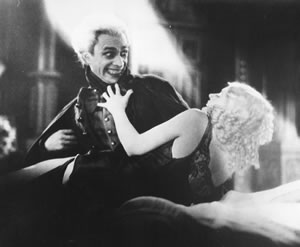
This still frame image from ‘’the man who laughs’’ displays a self-centred, gold digging woman seducing a strange, vulnerable looking man. This black and white image shows a representation of wealth and fortune, judging by the Mise-en-scene surrounding the actors and the props worn by them. The dark contrast and gloomy colours are used in this image to construct the kind of atmosphere a horror thriller would often have.
Title sequence research
http://www.artofthetitle.com/


This title sequence from ‘the girl with a dragon tattoo’ was described as an ‘elegantly violent title sequence’, an interesting oxymoron and choice of words. The unique title sequence included a variety of different shots, colours and images. There are many shots in the sequence which signify death, an example would be the bird set blazing. Dark colours such as black, connote an evil and sinister atmosphere and so does the Gothic music which intensifies in its pitch towards the end.
I chose to do a short analysis of this particular title sequence because of the strange an unusual effects and shots used to introduce the sequence. overall, i didnt feel as though the design of the title sequence went into depth of what to expect and by doing that, left me thinking of the possible plot and storyline of the movie and what could happen next. VERY WELL DONE TITLE SEQUENCE! :)


This title sequence from ‘the girl with a dragon tattoo’ was described as an ‘elegantly violent title sequence’, an interesting oxymoron and choice of words. The unique title sequence included a variety of different shots, colours and images. There are many shots in the sequence which signify death, an example would be the bird set blazing. Dark colours such as black, connote an evil and sinister atmosphere and so does the Gothic music which intensifies in its pitch towards the end.
I chose to do a short analysis of this particular title sequence because of the strange an unusual effects and shots used to introduce the sequence. overall, i didnt feel as though the design of the title sequence went into depth of what to expect and by doing that, left me thinking of the possible plot and storyline of the movie and what could happen next. VERY WELL DONE TITLE SEQUENCE! :)
Title sequences
http://www.youtube.com/watch?v=4thzyFFdvVc
The title sequence for the movie ‘seven’ which was made by Kyle cooper is an example of a unique and diverse sequence. The title sequence was called a ‘piece of art’ by the New York times. By watching it, I saw that the story projected by what Cooper constructed, showed evidence of art.This overall sequence made it obvious that we should brace ourselves to witness a thriller that has been used to gain a viewer complete attention and make sure we are completely concentrated. Kyle cooper has almost used the title sequence of the movie as a mini movie itself, giving us insight of the genre of the movie, the sinister atmosphere, the possible characters and the narrative of the movie.
Subscribe to:
Posts (Atom)